Acajutla: Where the Road Shakes You and the Pacific Heals You
A journey to Acajutla reveals a working port city often overlooked by travelers, where volcanic beaches and sweeping Pacific views quietly reward those who stop to explore. From botanical gardens and oceanfront dining to bumpy dirt roads leading to a peaceful coastal bungalow, this story shows how the most memorable moments often come after the hardest drives.
3/7/2026
Some places announce themselves with beauty the moment you arrive.
Others make you work for it.
Acajutla, on El Salvador’s northwestern Pacific coast, is one of those places.
The journey begins about two hours outside San Salvador, along smooth highways that feel almost luxurious by Central American standards. The road glides forward effortlessly, trees framing the horizon, the countryside opening wide in stretches of green.
The drive itself becomes part of the experience — a quiet reminder that sometimes the road matters just as much as the destination.
A City Built for Work, Not Applause
With roughly 55,000 residents, Acajutla serves as El Salvador’s principal seaport. From its harbor, cargo ships carry coffee, sugar, and the prized Balsam of Peru to distant markets.
It is the country’s foremost industrial maritime hub — functional, busy, and efficient.
Beautiful?
Not exactly.
And that’s precisely why many travelers pass it by.
But beyond the cranes, warehouses, and shipping lanes, Acajutla reveals a quieter side for those willing to explore. Surfers come for nearby beaches where waves range from gentle beginner swells to challenging breaks that test even seasoned riders.
And hidden above the city sits a peaceful retreat.
A Garden Above the Heat
Fuente de Flores Parque Botánico is a beloved local park — part botanical garden, part gathering space, and part playground beneath open skies.
Flowers bloom everywhere, splashing the landscape with color. Families stroll through shaded paths. Children chase each other between trees.
It’s calm.
Except for the heat.
Because the moment I step out of the car, Acajutla introduces itself properly.
And aggressively.
El Salvador is hot everywhere except the mountains — but this heat is something else entirely. The kind that makes you question your outfit, your life choices, and whether walking uphill is a personal mistake.
Humidity wraps around you like a wet blanket.
But the view waiting at the top makes it worth every step.
At the top of the park sits a mirador, offering a sweeping view of the city and the endless Pacific beyond.
Meeting the Pacific
And for someone from the eastern United States, this moment carries weight.
I never see the Pacific.
Standing there, watching it stretch endlessly toward the horizon, I can only think one thing:
Oh my God. It’s magnificent.
Below the cliffs, a small cave opens along the rocky coastline — fascinating to look at, though reaching it would involve a descent that ends somewhere between adventurous and reckless.
So I admire it from above.
Lunch With the Ocean
Eventually, practicality wins.
It’s time to find food.
Nearby sits Restaurante Café La Cueva, perched above the water like it was designed specifically for moments like this.
The menu is heavily focused on fish — not ideal for someone who eats neither meat nor seafood.
But where there are restaurants, there are usually French fries.
And where there are French fries, there is hope.
The waiter is wonderfully accommodating and spoke English.
“Rice and beans together,” he explains with a smile. “We call it casamiento.”
Perfect.
Grilled vegetables. Casamiento. French fries.
No meat. No fish. No cheese.
Simple. Honest. Delicious.
But truthfully, the food almost doesn’t matter.
Because the Pacific Ocean is right there.
Waves rolling endlessly. Salt air drifting across the table. The horizon stretching farther than my eyes can follow.
Leaving the Pavement Behind
Eventually, it’s time to leave Acajutla and find my accommodation somewhere outside the city.
And once again — the main roads in El Salvador deserve their praise.
They are excellent.
Truly.
Chef’s kiss.
But the moment you leave them, the road looks at you and says:
Good luck, traveler.
The pavement disappears. Dirt replaces asphalt. Gravel crunches beneath the tires.
And then comes the water.
The Pond That Pretended to Be a Road
Ahead of me lies what can only be described as a miniature pond pretending to be part of the road.
In the middle of nowhere.
No cars. No locals. No helpful driver to test it first.
Just me.
And some cows who clearly want no part in this decision.
There is, however, a pedestrian bridge beside it.
Which means everyone knows this water crossing exists.
It has tenure.
If this were my first day in El Salvador, I would turn around immediately.
But it’s not.
At this point, I’m practically Salvadoran.
So I conduct a scientific experiment.
I throw a rock.
Ripples.
Promising.
Another rock.
Still good.
Decision made.
Full steam ahead.
Arrival at the Edge
After the dirt roads, the water crossings, and more than a few emotional negotiations with gravity, I finally arrive at NAIA Miraville.
The gate is closed, naturally.
But a kind family living nearby opens it for me.
And most importantly, I’ve arrived before sunset.
A victory.
The Welcome Committee
Two dogs — Naia and Coco — greet me immediately.
At that moment, the stress dissolves.
The ocean view becomes secondary.
The dogs steal the show.
My bungalow sits perched above the shoreline, requiring a climb up a set of very character-building stairs. Thankfully, the staff helps with my luggage — I’ve used up all my courage just getting here.
Inside the bungalow:
a balcony overlooking the Pacific
a mini fridge
space to hang clothes
a large, spotless bathroom
air conditioning (blessed relief)
strong WiFi
And outside… The sound of waves. All night long.
The Road Was Worth It
Later, walking down to the beach, the frustration of the journey begins to fade.
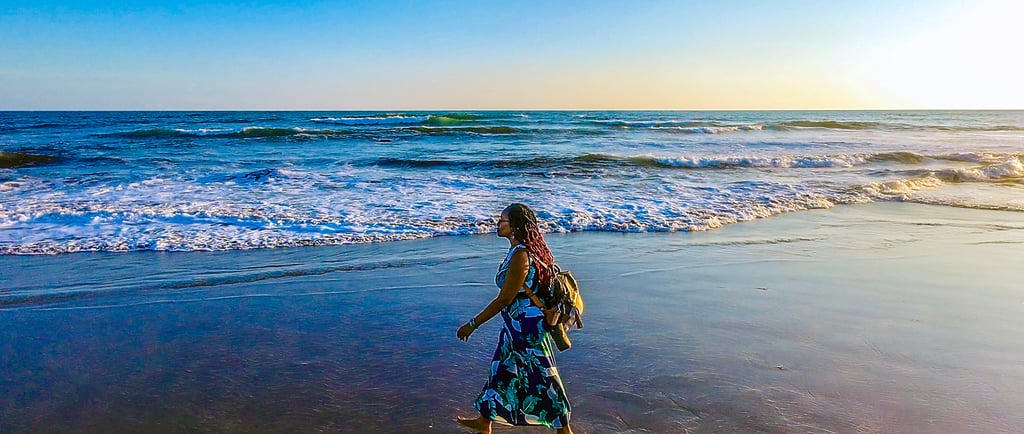
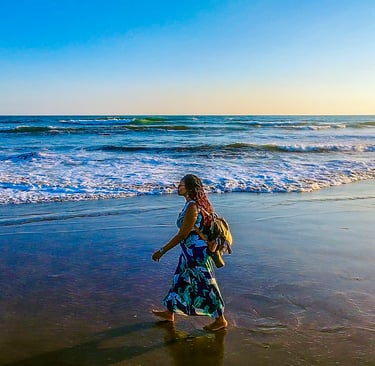
Black volcanic sand stretches beneath my feet.
The Pacific rolls endlessly toward the horizon.
And the sun softens into red and violet tones as it sinks into the water.
The road to get here was brutal.
Loose gravel. Deep ruts. Sudden ponds. Long stretches where every decision felt questionable.
But now…
I’m here.
And it feels impossible that an hour ago I was gripping the steering wheel like my life depended on it.
This beach doesn’t sparkle or shout.
It’s quiet. Ancient. Grounded.
The dark sand carries the memory of volcanic fire — the same forces that shaped this coastline and made the journey so difficult.
And maybe that’s the lesson.
Some places make you earn the calm.
They test you before they reward you.
The road shakes you.
But the ocean restores you.
And as the waves keep their steady rhythm and the sky deepens into evening, one truth settles in:
Some beauty isn’t meant to be easy.
It’s meant to be felt — after you arrive.
Vlogs
Watch the stories that unfold beyond words and photographs.
© 2026. All rights reserved.

Subscribe