Exploring Cihuatán: The Lost City Next to the Woman
A reflective journey into Cihuatán, El Salvador’s forgotten city, where collapse gave way to reinvention, cultures blended in quiet resilience, and fire ultimately sealed a mystery still buried beneath the stones.
In a valley shaped by rivers and volcanoes, a city once rose from untouched soil. It was born as other great civilizations were collapsing—a late arrival to a world already unraveling. Cultures converged here. Ideas flowed in from distant regions. And above it all loomed the silhouette of a woman—a goddess, according to local legend—said to watch over the land.
The promise didn’t last.
Within a century, the city was gone. Abandoned. Burned. Reduced to ruins and questions.
This is Cihuatán—El Salvador’s largest pre-Columbian archaeological site, and one of its most haunting.
Getting There: When the Road Gives Up
Cihuatán sits about 90 minutes from San Salvador, or roughly half that if you’re coming from Suchitoto. That sounds short—until you remember that in El Salvador, time is more of a suggestion than a rule.
The drive starts off deceptively smooth. Wide, confidence-boosting roads lull you into thinking, Wow, this is easy. Then—without ceremony—the pavement quietly clocks out. Suddenly you’re on a road that feels less “tourist attraction” and more “archaeological side quest.”
Hardly anyone makes this turn. The result? A peaceful, scenic, slightly adventurous drive that ends somewhere extraordinary.
First Stop: The Museum That Makes You Imagine
The entrance fee for foreign visitors is $6 ($5 admission, $1 parking). And you know me—museum first.
The on-site museum is small, quiet, and deeply committed to the idea that reading is the real attraction. There are no glittering artifacts. None. Zero.
Instead, you’re given something better: context.
What emerges is a story of cultural remixing. Ceramics found at Cihuatán include dramatic effigies of central Mexican deities alongside utilitarian cooking vessels typical of southern Mesoamerica during the Early Postclassic period. There are human figurines. Even wheeled figurines—suggesting that the concept of the wheel existed here long before Europeans arrived.
Obsidian dominates the record: blades, tools, cores. Projectile points are rare, hinting that hunting and warfare weren’t the city’s primary focus.
Quietly, the museum makes its case: Cihuatán wasn’t isolated. It was connected—drawing ideas from Veracruz, the Gulf Coast, and central Mexico, then blending them with local Maya traditions into something entirely its own.
A City Born from Collapse
The name Cihuatán means “Place Next to the Woman” in Nahuatl.
Founded in the late 8th or early 9th century CE, it emerged during the Terminal Classic period—a time when great Maya cities were falling one by one. Palenque, Copán, Tikal, Calakmul—finished.
Cihuatán, somehow, was just getting started.
Unlike many ancient cities, it wasn’t built atop older settlements. This land had never been occupied before. That alone raises questions: Why here? Why then?
The answer may lie in geography. The city commands the fertile valley between the Acelhuate and Lempa rivers, with access to key waterways. To the southeast rises the Guazapa volcano, whose reclining shape resembles a woman. Local legend says she fell in love with the land and now protects it.
If you squint—and let your imagination work—you can almost see her.
Walking Through the Ruins
Only about a square mile of Cihuatán is open to visitors, but within that space are three ceremonial centers, residential zones, and what archaeologists believe was a marketplace. Roughly 150 structures have been identified, with many more still buried.
That makes Cihuatán the largest pre-Columbian site in El Salvador—and possibly the largest between Guatemala and Peru.
And yet, when I was there, it was silent.
No tour buses. No crowds. Just ruins and wind.
Ball Courts and Boundaries
The North and West Ball Courts follow the classic I-shaped design of the Terminal Classic period. The shape may have been practical—keeping the ball in play—but ball courts were never just about sport. They were cosmic spaces, ritualized arenas where competition, myth, and order collided.
Fragments of a massive outer wall—once six feet high—still encircle parts of the city. Was it defensive? Or was it marking sacred space? Rain drains built into its base suggest thoughtful engineering, but its true purpose remains a mystery.
At Cihuatán, questions outnumber answers.
The Pyramid and the Acropolis
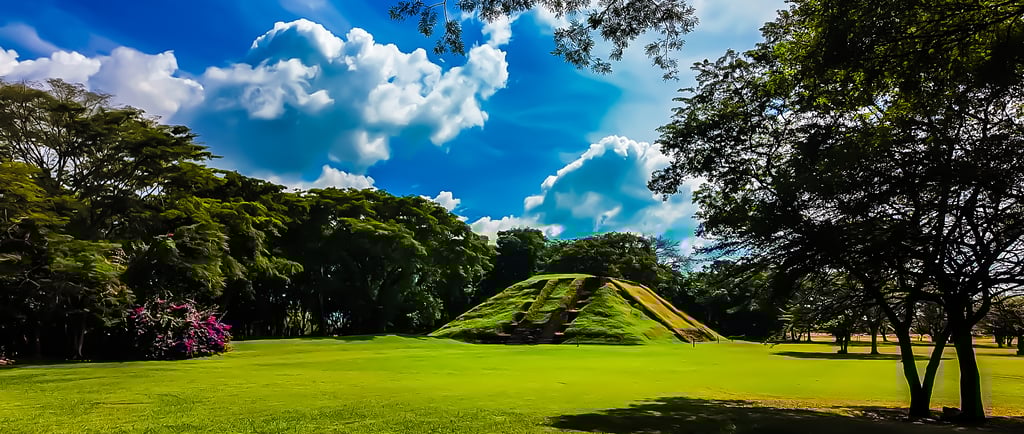
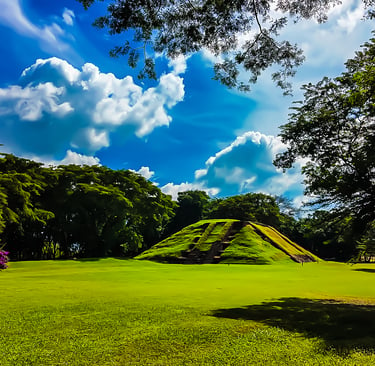
The main ceremonial plaza is dominated by a pyramid rising nearly 40 feet above the valley floor. Its temple is long gone, but the view from the top still connects sky, land, and ritual.
Nearby, the Acropolis—now beyond the visitor fence—reveals the foundations of a palace complex: courtyards, passageways, and evidence of multi-story construction. A palace means royalty. Yet Cihuatán has yielded almost no glyphic inscriptions.
Who ruled here? We don’t know.
Some scholars suggest outsiders—migrants from the Guatemalan Highlands, central Mexico, or even Belize—arrived after the Maya collapse and formed a new elite.
Daily Life in a Fragile City
The residential area tells a quieter story. Built of mudbrick and thatch, these structures were never meant to last centuries. Without a protective layer of volcanic ash—like at Joya de Cerén—time erased most of them.
What remains suggests homes, storage buildings, and surplus facilities. Between the rivers and the volcano, this land was agriculturally rich. Imagine maize fields stretching in every direction.
Nearby terraces likely served as a marketplace. Archaeologists have found evidence of obsidian workshops producing blades at scale, along with cotton spinning tools—signs of a bustling economy tied into regional trade networks.
This was not a struggling settlement. It was thriving.
Fire, Violence, and a Sudden End
Cihuatán’s story ends violently.
The city was destroyed by a massive fire. This was no accident.
Spear points were found among charred human remains. Skeletons appeared in Acropolis drainage systems—suggesting people hid there or were thrown in after death. The archaeological record is chilling.
Who did this?
External invaders? Internal revolt? Trade warfare? Cultural conflict?
No one knows. If the outer wall was defensive, it hints at outside attackers. But after the destruction, no one reclaimed the site—not until the Spanish arrived centuries later.
Those who survived fled, abandoning everything. The truth burned with the city.
Why Cihuatán Matters
I like to imagine Cihuatán as an Atlantis of determination—a refuge born from collapse. A place where people fleeing failed systems tried something new. Cultures meshed. Traditions blended. For a moment, it worked.
That’s just my imagination.
What we do know is this: Cihuatán stands as a testament to resilience during the Maya collapse—and as a warning of how quickly even the most promising civilizations can vanish.
Its secrets are still buried beneath these stones.
Waiting.
Would you visit Cihuatán?
If you ever find yourself in El Salvador, this forgotten city is absolutely worth the journey—unfinished roads and all.
Vlogs
Watch the stories that unfold beyond words and photographs.
© 2026. All rights reserved.

Subscribe