Panchimalco: Where History, Heritage, and Legend Meet
Blog post description.Panchimalco is one of El Salvador’s most fascinating colonial towns, where vibrant Indigenous heritage, centuries-old architecture, and enduring legends come together just minutes from the capital. From colorful streets and sacred traditions to the historic Church of Santa Cruz de Roma and stories of the mysterious Black Knight, this journey explores a place where history isn’t merely preserved—it continues to live, breathe, and shape everyday life.
5/30/2026
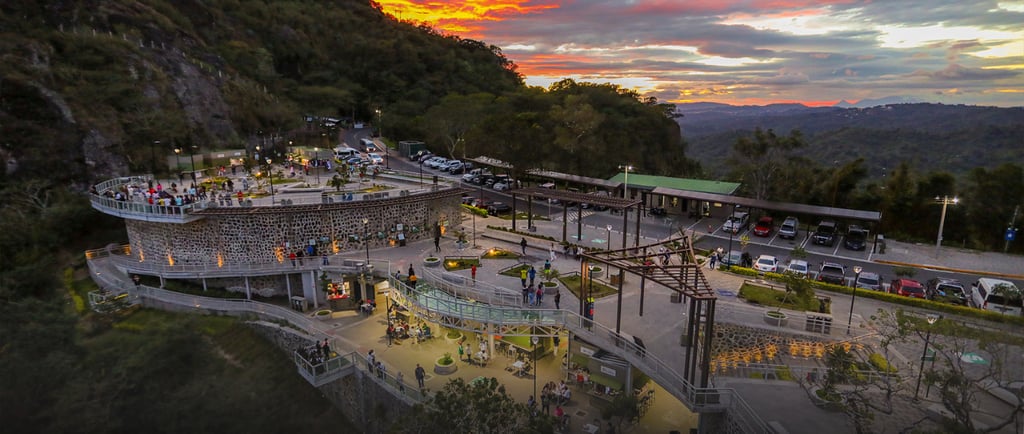
Just eleven miles south of San Salvador, nestled among rolling hills and sweeping vistas, lies Panchimalco—a place where history feels alive and every colorful street seems to hold a story.
Its name means "Place of Shields and Flags," a fitting title for a town that has long stood as a guardian of culture, tradition, and memory.
Despite being the colonial town closest to the capital, Panchimalco feels worlds away from the bustle of city life. Home to fewer than 50,000 residents, it retains the warmth, intimacy, and unhurried rhythm of a small community where traditions endure and neighbors still know one another by name.
From the moment you arrive, color greets you.
It spills across walls in vibrant murals. It decorates homes and storefronts. It brightens plazas and alleyways. Even the cemetery, perched against breathtaking views of the surrounding landscape, feels alive with color—an unexpected blend of beauty, remembrance, and reverence.
But Panchimalco's greatest treasure isn't found in its streets or scenery.
It's found in its people.
A Living Indigenous Legacy
What truly distinguishes Panchimalco from other colonial towns is its deep indigenous heritage.
During the Spanish conquest, the region became a refuge for descendants of the Pipil and Maya peoples. Here, traditions survived that were lost elsewhere, preserved through generations who refused to let their culture disappear.
Today, Panchimalco remains one of the strongest living expressions of Indigenous identity in El Salvador.
Though the Nahuatl language is no longer commonly spoken, the spirit of the ancestors remains visible everywhere—in colorful woven textiles, community celebrations, traditional crafts, and customs that continue to shape daily life.
History here isn't something locked away in museums.
It walks the streets.
The Heart of Town
Like many colonial settlements throughout Latin America, Panchimalco centers around a picturesque plaza where daily life unfolds beneath the shade of a magnificent cypress tree.
Facing the square stands one of the town's greatest treasures:
Church of Santa Cruz de Roma
Its striking white façade rises above the plaza, a beacon of resilience and faith that has endured for centuries.
Constructed in the early eighteenth century, it is among the oldest colonial churches in El Salvador and one of the country's most important architectural landmarks.
The church's thick walls were designed to withstand earthquakes—a necessity in a country shaped by both volcanic and seismic forces.
And withstand them it has.
A Sanctuary Through Time
Stepping inside feels like stepping backward through centuries.
Cherrywood pews rest upon traditional red brick floors.
Sixteen wooden columns rise gracefully from stone bases, separating the central nave from the side aisles.
Above, the ceiling curves like the inverted hull of a great ship, creating a sense of shelter and movement at the same time.
The sanctuary houses remarkable Spanish Baroque altars, intricate carvings, and religious paintings that have survived earthquakes, storms, and the passage of time itself.
At the center stands the church's original gilded altar, still glowing softly after centuries of devotion.
It is a place that feels less like a museum and more like a living witness.
The walls have seen generations come and go.
And somehow, they continue to stand.
When History Becomes Legend
Panchimalco is a town where history and folklore intertwine so seamlessly that separating one from the other becomes nearly impossible.
This is where the legend of the mysterious Black Knight takes root. Some believe the tale is more than a ghost story - that the Knight and a young woman named María Renderos rode a mighty black steed straight through the mountain creating La Puerta del Diablo - the Devil's Door.
Others suggest it may be a symbolic retelling of the earthquakes and landslides that have repeatedly reshaped this region throughout history.
One such catastrophe occurred in 1736, when a powerful earthquake severely damaged the church.
Yet the structure survived.
To some, that endurance is simply good engineering.
To others, it is something more.
Divine protection.
Ancestral memory.
Or perhaps a little of both.
A Town Worth Discovering
Panchimalco is a place where stories linger.
They drift through the branches of ancient trees.
They echo from colonial walls.
They live within the traditions of the people who call this town home.
It is a place where Indigenous heritage remains vibrant, where history feels tangible, and where legend still walks alongside everyday life.
Whether you come for the breathtaking views, the remarkable architecture, the living culture, or the stories whispered through the centuries, Panchimalco offers something increasingly rare:
Authenticity.
And perhaps that's why it leaves such a lasting impression.
Because long after you leave, Panchimalco stays with you.
A place where history still breathes.
And where even the Devil is said to have left footprints behind.
Vlogs
Watch the stories that unfold beyond words and photographs.
© 2026. All rights reserved.

Subscribe