Plaza Libertad and El Rosario: Where El Salvador Found Its Voice
Plaza Libertad and Iglesia El Rosario reveal the heart and soul of San Salvador, where the story of El Salvador’s fight for independence meets one of the most extraordinary churches in Latin America. From the Monument to the Heroes and the First Cry of Independence to the breathtaking rainbow-lit sanctuary of El Rosario, this journey explores a city where history, faith, architecture, and national identity continue to shape the present in remarkable ways.
6/6/2026
At the heart of San Salvador stands a place where history, faith, and national identity converge: Plaza Libertad.
More than a beautiful square, Plaza Libertad is widely regarded as the birthplace of modern El Salvador—a place where the first sparks of independence were lit and where the story of a nation began.
Surrounded by elegant architecture and bustling city life, the plaza remains one of the capital's most vibrant gathering places. Art, food, music, and daily life flow through the square, connecting present-day San Salvador to the generations who came before.
At its center rises the magnificent Monument to the Heroes, erected to commemorate the centennial of the First Cry of Independence in 1811. Towering above the plaza, an angel of freedom extends laurel wreaths toward the city below, embodying the courage and aspirations of those who dreamed of a nation free from colonial rule.
Fulanos Coffee
👉 Fulanos Coffee: a un costado de Catedral Metropolitana de San Salvador, 2a Avenida Sur, San Salvador, El
Among the figures immortalized here are José Matías Delgado, revered as the Father of the Salvadoran Fatherland, and Manuel José Arce, who would later become the first president of the Federal Republic of Central America. Their names are more than historical footnotes—they are woven into the very identity of the country.
As I stand here, I find myself returning to one of my favorite cafés in the historic center because, once again, El Salvador's heat remains undefeated.
The atmosphere inside is so good it could probably power half the city.
Now, if you've followed my travels for any amount of time, you know I don't drink coffee. Coffee and I have maintained a respectful distance for years. But this place serves café con limonada—a combination of coffee and lemonade that sounds completely unreasonable until you try it.
And somehow...
It works.
In fact, it might be one of the most delicious drinks I've had in El Salvador.
The First Cry of Independence
To understand Plaza Libertad, you must first understand an event that took place thousands of miles away.
In 1808, Napoleon Bonaparte invaded Spain and removed King Ferdinand VII from power, replacing him with his brother Joseph Bonaparte. Across Spain's colonies, outrage spread. Without a legitimate king, questions of sovereignty and self-governance suddenly became impossible to ignore.
Three years later, on November 5, 1811, José Matías Delgado, his nephew Manuel José Arce, and hundreds of armed patriots seized control of San Salvador and forced the colonial governor to resign. Though Spanish authorities quickly crushed the rebellion, the event became known as the First Cry of Independence—the moment when the dream of freedom first found its voice in El Salvador.
A decade later, independence would finally be achieved.
But freedom brought new questions.
Should El Salvador stand alone?
Or should it join a larger Central American nation?
In 1823, El Salvador joined Guatemala, Honduras, Nicaragua, and Costa Rica in forming the Federal Republic of Central America. Manuel José Arce became its first president, and for a brief moment, a united Central America seemed possible. Yet political divisions and regional rivalries eventually fractured the federation. By 1841, El Salvador emerged as an independent republic, ending one experiment and beginning another.
The Church That Doesn't Look Like a Church
Just beyond Plaza Libertad stands one of the most remarkable buildings in all of El Salvador:
Iglesia El Rosario.
And if you're standing behind it, you may not even realize it's a church.
The exterior is stark. Angular. Unadorned.
Without the cross, many visitors mistake it for something else entirely.
That confusion is understandable.
Because El Rosario is unlike almost every church you'll ever see.
The site itself carries deep historical significance. It occupies the location of San Salvador's original cathedral, first built in 1808. Earthquakes severely damaged that structure before ultimately destroying it, leaving the site dormant for decades. Then, in 1971, architect Rubén Martínez Bulnes transformed the ruins into something entirely new.
The result is one of the world's most striking examples of Brutalist religious architecture.
Raw concrete.
Clean geometry.
Minimal ornamentation.
From the outside, it feels almost severe.
And then you walk inside.
Everything changes.
A Cathedral of Light
The moment you enter El Rosario, you understand why it is considered one of the architectural masterpieces of Latin America.
Gone are the elaborate baroque altars, gothic spires, and heavily ornamented interiors common throughout the region.
Instead, the church opens into a vast, unobstructed sanctuary.
Cherrywood pews line a checkerboard floor.
The altar remains visible from every angle.
And above it all rises the church's defining feature:
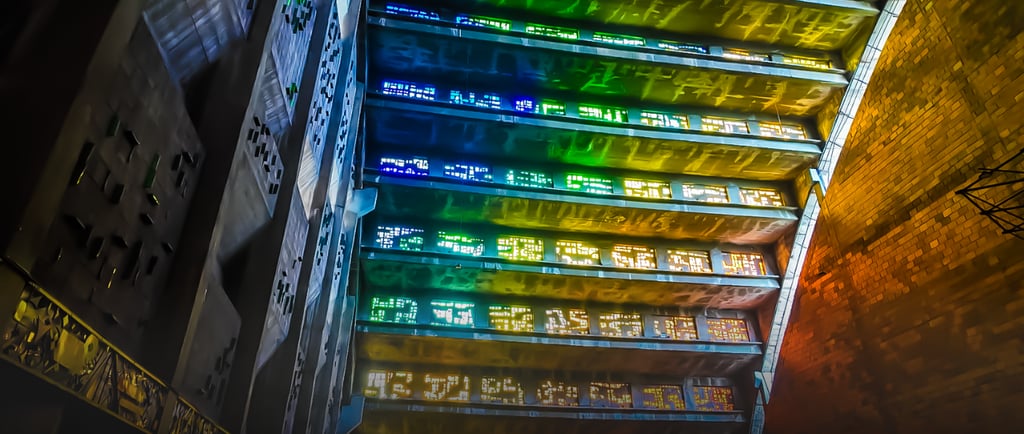
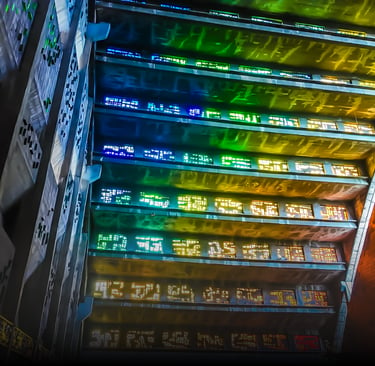
A sweeping arc of stained glass imported from France.
Unlike traditional church windows depicting saints or biblical scenes, these geometric panels create a cascade of color that pours across the sanctuary throughout the day. Blues, reds, greens, yellows, and violets spill across the concrete walls like liquid light. The famous "Stairway to Heaven" design rises above the sanctuary, while the mosaic known as the "Eye of God" anchors the space in radiant color.
It feels less like stepping into a building and more like stepping inside a prism.
Faith, Art, and Memory
Despite its modern appearance, El Rosario remains deeply rooted in Catholic tradition.
The church is dedicated to Our Lady of the Rosary and reflects the spiritual heritage of the Dominican Order founded by Saint Dominic centuries ago. Throughout the sanctuary, abstract sculptures reinterpret the Stations of the Cross using pumice stone, iron, rebar, and concrete. The final station depicts the Resurrection, transforming the traditional narrative from one of sorrow into one of hope.
Beneath the sanctuary lies a crypt containing the remains of some of El Salvador's most influential figures.
Among them is José Matías Delgado, whose actions helped ignite the country's independence movement. Nearby rests Rubén Martínez Bulnes, the architect whose vision created this extraordinary space. Their presence links the nation's political and artistic histories beneath the same roof.
Walking through El Rosario feels strangely familiar.
Though the church was completed decades before many modern worship spaces in the United States, its open design, simplicity, and emphasis on light feel remarkably contemporary.
Martínez Bulnes wasn't merely an architect.
He was a visionary.
Where Past and Present Meet
As I leave San Salvador's historic center, I find myself reflecting on the remarkable contrast between these two landmarks.
Plaza Libertad tells the story of a people who dreamed of freedom.
Iglesia El Rosario tells the story of a people willing to reinvent tradition.
Together, they capture something essential about El Salvador itself—a nation shaped by resilience, faith, creativity, and courage.
Here, history is not confined to monuments.
It lives in the streets.
It glows through stained glass.
And it continues to inspire everyone willing to stop and listen.
Vlogs
Watch the stories that unfold beyond words and photographs.
© 2026. All rights reserved.

Subscribe