Suchitoto: Where Time Slows and the Past Still Speaks
A journey to Suchitoto unfolds at an unhurried pace, where cobblestone streets, layered history, and the quiet beauty of Lake Suchitlán invite reflection. From colonial charm to deeper truths about the land and its people, this story explores a place where the past lingers—and the present asks you to slow down and listen.
3/21/2026
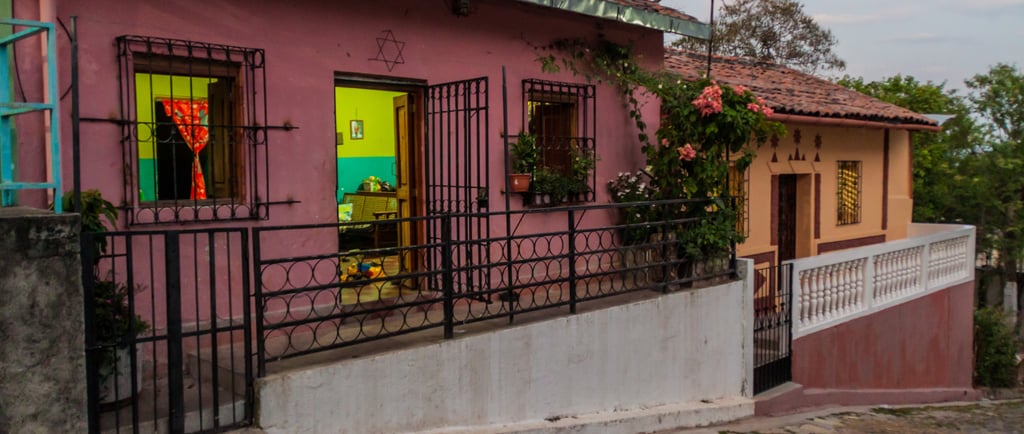
Situated between the looming presence of Guazapa Volcano and the shimmering expanse of Lake Suchitlán, the road to Suchitoto unfolds gently—almost intentionally unhurried. It’s about an hour east of San Salvador, and for the most part, the journey is smooth, welcoming, and deceptively easy.
But every so often, the road reminds you that you are not in control here.
A sudden speed bump.
A cow standing confidently in the middle of your lane.
A quiet assertion: you are a guest.
The Kind of Places That Don’t Announce Themselves
Along the way, you pass through small towns that don’t introduce themselves.
No signs. No spectacle.
Just life.
People sweeping doorways. Conversations unfolding on street corners. Daily rhythms that exist entirely independent of your presence.
It’s quiet. Grounded. Real.
And then—without ceremony—you arrive.
The pavement disappears. Cobblestone takes over. The car slows. Your body feels it before your mind catches up.
This is Suchitoto.
And the road itself has already begun the lesson:
Slow down.
The Place of Birds and Flowers
The name Suchitoto comes from Nahuatl, meaning “place of birds and flowers.”
It’s a name that feels earned.
Long before Spanish conquest, this region was home to Nahuatl-speaking peoples who lived in rhythm with the Lempa River, the surrounding forests, and the chorus of birds that filled the air.
But like much of Central America, this land carries a layered past.
In 1524, Pedro de Alvarado advanced into the region after subduing the Mayan highlands. Indigenous resistance initially pushed back—but the Spanish returned.
By 1528, control was established.
Suchitoto became a colonial capital.
And then, in 1545, the capital moved.
Suchitoto was left behind.
A Town That Refused to Disappear
But not everyone left.
The town endured.
Today, around 25,000 people call Suchitoto home—a living memory shaped by resilience, history, and quiet continuity.
And walking its streets brings a complicated feeling.
Because colonialism is not easy to hold.
It carries loss. Violence. Erasure.
And yet…
The architecture is beautiful.
The colors are captivating.
The streets invite you to linger.
It’s a contradiction I couldn’t ignore.
I found myself imagining the past—not just the events, but the people.
The women who lived here.
Indigenous and European alike.
What did they worry about? What made them laugh? What felt ordinary in a world that now feels impossibly distant?
And then the question shifts:
If they saw Suchitoto today… would they recognize it?
Or would it feel just as foreign to them as their world feels to us?
That tension—between beauty and brutality—is part of what makes this place so powerful.
Monday: The Day Everything Closes
If you visit Suchitoto on a Monday, just know:
Everything is closed.
Museums? Closed.
Church? Closed.
Dreams of cultural enrichment? Also closed.
But there is one thing they cannot close.
The lake.
Lake Suchitlán: Beauty With a Backstory
A boat tour on Lake Suchitlán costs about $25 and promises panoramic views and an island stop.
What it does not promise is narration.
My captain chose silence.
Absolute silence.
No facts. No commentary. No “on your left, you’ll see…”
Just wind, water, and my own thoughts.
Which, honestly, was fine.
Because I had done my research.
And the lake was speaking for itself.
A Lake Made by Power—and Pressure
Lake Suchitlán is the largest body of water in El Salvador, spanning over 50 square miles.
It was created between 1973 and 1976 with the construction of the Cerrón Grande Dam along the Lempa River.
Today, it produces the largest share of the country’s electrical energy.
It is both vital… and vulnerable.
Birdlife thrives here. Migratory species pass through. Fish, reptiles, and mammals depend on its waters.
But so does pollution.
The Truth Beneath the Surface
From a distance, the lake is serene.
Up close, the truth becomes harder to ignore.
Plastic bottles drift between reeds.
Wrappers cling to the shoreline.
Thick green mats of invasive water lettuce spread across the surface.
Much of this comes from the Lempa River, carrying waste from Guatemala through Honduras and into El Salvador.
And the signs are everywhere—once you see them:
Ducks navigating through trash
Turtles sunning themselves on plastic
Horses drinking from contaminated water
It is beautiful.
And it is struggling.
At one point, I thought:
Maybe I can film this without showing the pollution.
But then I realized—
I shouldn’t.
Because this matters.
Isla El Ermitaño: Where Silence Holds Stories
The boat stops at Isla El Ermitaño, named for a hermit who once lived there in solitude.
From 1989 to 2012, Don Carlos Lemus called this island home.
A man who chose silence over society.
But the island carries more than one story.
In 2014, a Salvadoran Air Force plane crashed into the waters nearby.
Four people were on board.
Only one survived.
At the top of the island, the remains of that aircraft sit exposed—twisted, still, heavy with meaning.
Standing there, it’s impossible not to feel small.
Whatever problems you carry… they shift in perspective.
A Stay That Pushed Me Out of My Comfort Zone
After the lake, I headed to my accommodation.
And this is where things get interesting.
Because for the first time, I wasn’t staying alone.
I booked a room in someone’s home.
For context:
I am an only child. An Aquarius. Independent to my core.
This is… not my natural setting.
But something about Elisabeth’s listing moved me.
So here I am.
Casa Lichis: A Colonial Pause
At Casa Lichis, I have my own private room—complete with a key, which makes me feel both secure and slightly important.
The space is simple and beautiful:
red tile floors
wooden furniture
white walls
soft, minimal design
There are three beds (for reasons unknown), but I chose the one with the mosquito net.
Not for practicality.
For drama.
There’s WiFi, air conditioning (blessings), and a bathroom with—predictably—no hot water.
At this point, I accept that hot water in El Salvador is more of a personality trait than a guarantee.
Click here for the listing.
Suchitoto After Dark
Even though it’s only early evening, the town transforms quickly.
Darkness settles fast.
But the energy shifts.
You can hear it from the street.
Suchitoto comes alive at night.
So I head out in search of one simple thing:
A piña colada.
A Perfect Ending
A small restaurant just a few blocks away delivers exactly what I needed.
A vegan-friendly meal. Strong drinks. Warm atmosphere.
Simple.
Perfect.
Click here for the restaurant.
A Place Where Stories Linger
Suchitoto is not a place you rush through.
It is a place you listen to.
In its plazas, its lake, its quiet streets—the past is never fully gone.
It lingers.
It breathes.
It waits.
What began as a site of conquest has become something else entirely:
A sanctuary of culture, memory, and quiet beauty.
So if you find yourself here—
Walk slowly.
Listen carefully.
Because the land speaks.
And if you’re very quiet…
You might just hear the echo of something older still.
Vlogs
Watch the stories that unfold beyond words and photographs.
© 2026. All rights reserved.

Subscribe