Tazumal: Where El Salvador’s Deepest History Rises
An immersive walk through Tazumal reveals El Salvador’s most iconic Maya site as a living crossroads of power, resilience, and transformation—where ancient stone rises directly from the modern street and history refuses to stay buried.
1/17/2026
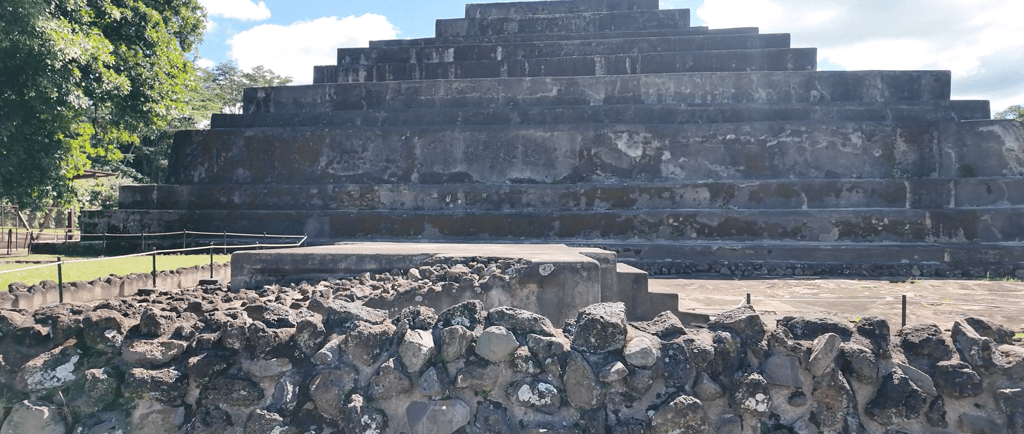
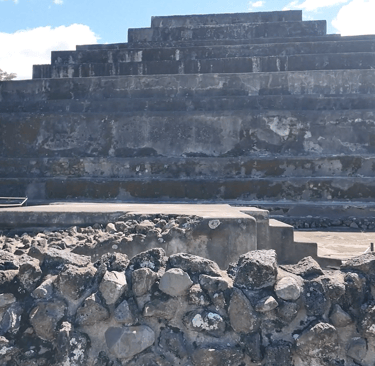
If you search for El Salvador and Maya, this is the place that appears again and again.
Not because it’s flashy.
Not because it’s hidden deep in the jungle.
But because it endures.
Tazumal is the country’s most iconic pre-Columbian landmark—a site so essential to El Salvador’s identity that it once appeared on the national currency. What stands here is not simply a ruin. It is memory made monumental.
And the most striking part?
You can see it from the street.
A Maya City in Plain Sight
Tazumal rises from the center of Chalchuapa, just north of Santa Ana—anchored not in isolation, but woven into everyday life. It sits at the end of a main avenue, enclosed by a modest fence, surrounded by houses, traffic, and the ordinary rhythms of a modern town.
Step out of your car and there it is.
Ancient. Unmistakable. Present.
Tazumal is part of the larger Chalchuapa Archaeological Zone, one of the most important cultural landscapes in El Salvador. Much of it remains hidden beneath the modern city, much like Kaminaljuyú beneath Guatemala City. Elsewhere, Maya structures still surface unexpectedly—in cemeteries, on private land, and among coffee fields.
This is living archaeology.
First Impressions: Jaguars, Warriors, and Stone Power
Entry costs $5 for foreign visitors, and the grounds are beautifully maintained—trimmed grass, shaded benches, flowering trees, and quiet corners designed for lingering rather than rushing.
Near the entrance, it’s easy to overlook a small but powerful guardian: the Piedra del Jaguar.
Carved from fine-grained andesite, this crouching feline is all muscle and tension, frozen mid-prowl. Jaguars were symbols of power, authority, and the sacred—creatures that moved between worlds. Sculptures like this signal that Chalchuapa was no provincial outpost. It was a serious player in the Mesoamerican world.
Nearby, another carved boulder captures a lone warrior mid-stride—weapon in hand, posture alert. Whether hunting or preparing for conflict, the image speaks to vigilance and purpose, to a world where identity, survival, and ritual were inseparable.
And before you’ve even entered the museum, there it is again: evidence of Tazumal as a cultural crossroads. A massive stone with clear Olmec-style features—linking this site to one of Mesoamerica’s earliest civilizations.
Welcome to a place that was connected long before borders existed.
Three Thousand Years in One Small Museum
The on-site museum may be modest in size, but it contains something vast: time.
Before Tazumal was a park, a monument, or a museum, people lived here continuously for millennia—farming, trading, burying their dead, and rebuilding again and again atop what came before. That continuity is what makes Chalchuapa extraordinary.
The name itself, derived from Nahuatl, roughly translates to “Green River.” A fitting name for land that kept calling people back.
Formal excavations began in the 1940s under Dr. Stanley H. Boggs, whose work uncovered the massive pyramid, surrounding platforms, ceramics, burials, jade, incense burners, and zoomorphic carvings. Dozens of tombs—individual and collective—were found embedded within the architecture itself.
So significant was the site that in 1947, before the museum even opened, Tazumal was declared a National Historical Monument. Later, its pyramid appeared on the 100 colones bill, meaning generations of Salvadorans quite literally carried Tazumal in their wallets.
Every artifact here whispers the same truth:
El Salvador did not begin with colonization.
It began here.
The Pyramid: A Thousand Years of Building
The centerpiece of Tazumal is its 75-foot-tall, multi-tiered pyramid, rising from an area known as the Temple of the Columns. What we see today is not a single construction, but the result of centuries of rebuilding.
Archaeological trenches reveal at least three earlier platforms beneath the visible structure, modified and rebuilt seven times before forming the massive base we see now.
Every major event—political, ritual, or social—meant renovation.
This wasn’t one build.
It was a thousand years of upgrades.
All structures face west, aligning ritual space with cosmology. Burials found within the pyramid precinct suggest both sacred and dynastic importance—places where power, ancestry, and belief converged.
Offerings, Trade, and a Connected World
Excavations at Tazumal have revealed offerings buried deep within the earth: ceramic vessels filled with jade, seashells carried inland from distant coasts, animal bones, sheets of shimmering mica, and most striking of all—green obsidian.
This obsidian did not come from anywhere near Chalchuapa. Its presence points to long-distance trade with the volcanic highlands of central Mexico, proving once again that Tazumal was never isolated.
Spiritually. Culturally. Commercially.
This city was plugged into a vast Mesoamerican network.
Fire, Collapse, and Return
Tazumal’s florescence was violently interrupted by the catastrophic eruption of Ilopango volcano in the 5th or 6th century CE. Ashfall and climate disruption devastated the region, severed trade routes, and forced widespread abandonment.
Centuries later, people returned.
To the southwest stands a second major structure built during the Late Classic period—smaller, but no less meaningful. Constructed in four stages atop earlier foundations, it features the talud-tablero style associated with Teotihuacán influence via Kaminaljuyú.
Resilience runs deep here.
Ball Courts and the Cycles of Life
One area of the site may represent a Classic-period ball court—unusual in its layout, partially built into the pyramid itself. While interpretation continues, offerings found here—including jade and bird bones—suggest ritual importance.
The Maya ball game was never just a sport. It was cosmology in motion, tied to cycles of life, death, and rebirth.
A more traditional I-shaped ball court exists nearby—unrestored and partially within a modern cemetery. Here, ancient ritual space and present-day life coexist quietly, without conflict.
Transformation, Not Disappearance
By around 900 CE, Tazumal was abandoned once again, likely connected to the broader collapse of major Maya cities. Later finds—including some of the earliest known gold artifacts in the Maya region—hint at Pipil presence, a Nahuat-speaking people who arrived after the Maya era.
As I step away from Tazumal, what stays with me isn’t just the scale of the stones—it’s the continuity.
This place was built, altered, buried, rediscovered, and built again. It survived fire, ash, abandonment, and time itself. What stands here now is not a ruin frozen in the past, but a conversation across centuries.
Tazumal reminds us that civilizations don’t vanish.
They transform.
And here, in the heart of Chalchuapa, that truth is written clearly—in earth and stone.
Tazumal isn’t just a place you visit.
It’s something you carry with you long after you leave.
Vlogs
Watch the stories that unfold beyond words and photographs.
© 2026. All rights reserved.

Subscribe